United Kingdom
Introduction
This report analyzes the strategic pathways, comparative advantages and constraints of the bioeconomy and electrification for the United Kingdom.
As nations face mounting climate pressures, establishing sustainable, low-carbon energy and material supply systems have become an economic imperative. Evaluating structural resources, capital availability, industrial demand, and infrastructure constraints provides a multidimensional framework for measuring the United Kingdom's industrial readiness. Integrating both approaches (a bioeconomy and electrification) effectively presents possible solutions to the unique systems challenge that requires targeted funding and supportive regulatory policy to ensure long-term supply resilience at least cost.
Report Summary
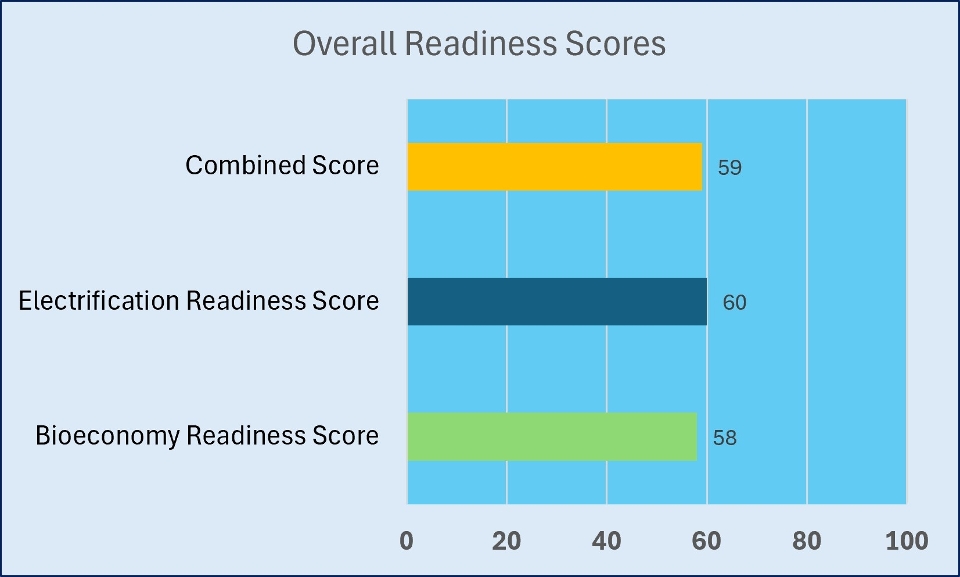
The report analyzes the comparative advantages of the bioeconomy and electrification pathways to create sustainable, resilient energy and material supply systems for the United Kingdom. Evaluated on a scale of 100, the UK achieves readiness scores of 58 for the bioeconomy and 60 for electrification, yielding a combined systems readiness score of 59.
The nation demonstrates exceptional strength in institutional policy support and market maturity for both sectors. Robust government frameworks and strong commercial appetites are ready to deploy clean energy technologies. However, critical bottlenecks threaten long-term resource sovereignty. The single greatest threat to the electrification roadmap is critical mineral security, scoring a critically low 15 out of 100. The global supply chain for vital electrical infrastructure components carries a severely concentrated Herfindahl-Hirschman Index score of 4,200. This exposure to intense geographic monopolies, particularly in China for refining rare earth elements and graphite, risks capital cost inflation and supply delays. Furthermore, high-value components for solar and offshore wind remain heavily dependent on foreign manufacturing, with infrastructure imports demanding 1.4% to 2.1% of the total annual UK import budget.
Concurrently, the bioeconomy faces severe physical land and resource constraints rooted in geography. Primary industries like agriculture, forestry, and fishing generate just 0.6% of national gross domestic product. Because of high population density and limited forest cover, the UK already imports 80% of its timber. Although domestic biomass availability could scale to 40 million dry tonnes annually, the nation cannot rely solely on domestic land mass to eliminate its renewable carbon dependency. Consequently, the report concludes that the UK must maintain a synchronized commitment to both pathways. Balancing massive grid electrification investments with localized advanced bio-refining will permanently displace volatile fossil fuel imports, secure domestic liquid fuel supplies, and establish future industrial resilience.