Bioeconomy & Electrification Readiness
Our bioeconomy and electrification assesments and scoring analysis provide insights to balance investment into these two energy transition pathways and to identify critical constraints preventing their implementation.
The transition to a low-carbon economy is often presented as a choice between electrification and the bioeconomy. In reality, it is neither. Around the world, governments, industries and investors are discovering that successful decarbonisation depends on balancing multiple technological pathways within the unique economic, resource, environmental and social conditions of each jurisdiction.
No country possesses identical combinations of renewable resources, biomass availability, industrial capability, critical minerals, infrastructure, capital, policy settings or market structures. Consequently, technologies that are economically attractive in one region may be technically constrained, financially prohibitive or environmentally sub-optimal in another. The transition is therefore not simply a technology challenge; it is fundamentally a systems challenge requiring the integration of energy, industry, natural resources, infrastructure, finance and public policy and identifying opportunities for energy exports.
Our review of hundreds of renewable energy, bioeconomy and industrial decarbonisation projects undertaken across Europe, North America, Asia-Pacific and other regions demonstrates that successful transitions are characterised by a common feature: they are strategically aligned with local comparative advantages rather than driven by technology preferences alone. Regions rich in forestry and agricultural resources have emerged as leaders in advanced biofuels, renewable chemicals and bioproducts, while jurisdictions with extensive renewable electricity resources, manufacturing capability and secure critical mineral supply chains have accelerated electrification. Increasingly, the highest-performing regions are those capable of integrating both approaches into resilient, diversified energy and industrial systems.
The complexity of these interactions is increasing. Electrification depends upon substantial investment in renewable generation, transmission networks, storage technologies, manufacturing capacity, diversifying the use of electricity and secure supplies of critical minerals such as copper, lithium, nickel and rare earth elements. The bioeconomy depends on reliable feedstock supplies, processing infrastructure, logistics, sustainable land and water management, industrial markets and supportive regulatory frameworks. Both pathways compete for capital, skilled labour, land, infrastructure and policy attention, while also being influenced by geopolitical risks, global supply chains, fiscal constraints and rapidly evolving technologies.
Traditional indicators—such as renewable electricity generation, installed capacity or emissions reductions—capture only part of this complexity. They provide limited insight into whether a country, region or community possesses the broader capability required to successfully implement and sustain either transition pathway. Equally, many existing energy planning tools optimise individual technologies or sectors but do not adequately capture broader issues such as supply chain resilience, critical mineral security, market concentration, industrial capability, regional competitiveness, external carbon emissions, or long-term economic resilience and competitive advantage.
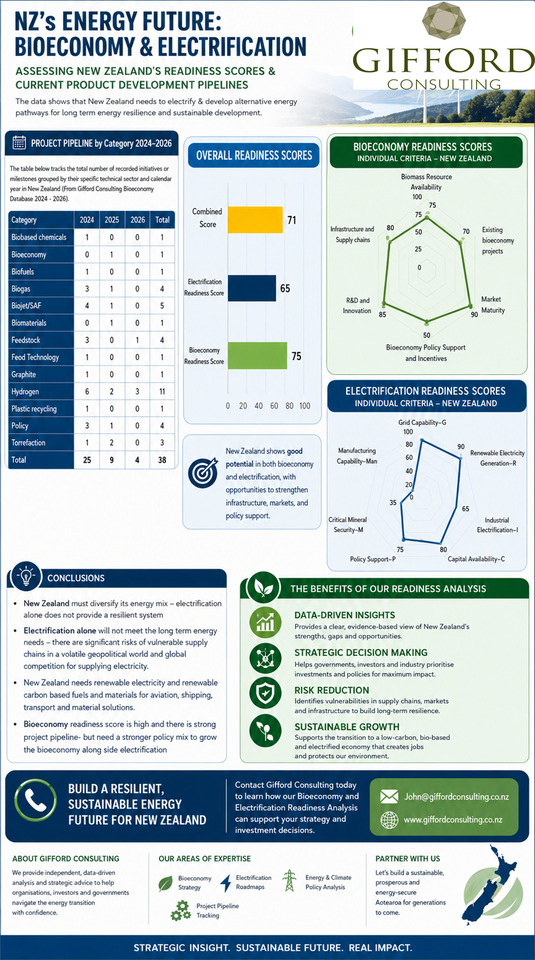
The Bioeconomy Readiness Score (BRS) and Electrification Readiness Score (ERS) have been developed to address this gap. Rather than measuring technology deployment alone, these frameworks assess the broader strategic conditions that determine whether investments are likely to succeed. They integrate indicators relating to resource availability, infrastructure, policy and regulation, innovation capacity, manufacturing capability, access to capital, market maturity, industrial demand and, where appropriate, critical mineral security. Together they provide a multidimensional assessment of a jurisdiction's capacity to develop competitive low-carbon industries and future energy supply resilience.
Importantly, the BRS and ERS are not intended to identify a single "winning" technology. Their purpose is to reveal where each pathway delivers the greatest strategic value and where integrated approaches are likely to produce superior outcomes. In many jurisdictions, electrification will provide the lowest-cost solution for buildings, light transport and distributed energy systems, while bio-based pathways will remain essential for aviation, shipping, heavy transport, industrial process heat, renewable fuels, chemicals, advanced materials and carbon management.
This distinction is becoming increasingly important as governments face tightening fiscal constraints, rising infrastructure costs, growing geopolitical uncertainty and increasing competition for capital and financial resources (e.g. increased expenditure on defence). Decisions made over the next two decades will shape industrial competitiveness, employment, regional development and energy security for generations. Investments directed toward technologies that are poorly aligned with regional strengths risk creating stranded assets, unnecessary public expenditure and slower progress towards climate objectives. Conversely, investment strategies that recognise regional comparative advantages can stimulate innovation, strengthen domestic industries, improve energy resilience and maximise long-term economic returns.
Contact us for further information regarding our Bioeconomy and Electrification Assessments
We have Bioeconomy and Electrification Assessments and Scores for:
- Australia
- New Zealand
- United Kingdom
A sample of our assessment for New Zealand is provided below