Australia
Introduction
This report analyzes the strategic pathways and comparative advantages of the bioeconomy and electrification in Australia.
As nations face mounting climate pressures, establishing sustainable, low-carbon energy and material supply systems has become an economic imperative. Evaluating structural resources, capital availability, industrial demand, and infrastructure constraints provides a multidimensional framework for measuring Australia's industrial readiness. Integrating both approaches effectively presents a unique systems challenge that requires targeted funding and supportive regulatory policy to ensure long-term supply resilience at least cost.
Australia's Bioeconomy
Australia is exceptionally well-positioned logistically but under-developed industrially for a bioeconomy. The nation commands roughly 78 to 80 million dry tonnes of sustainable, non-food biomass availability annually, predominantly from cropping and agricultural residues. Backed by an extensive 382-million-hectare grazing estate and 571 operational processing facilities, the country has the physical land area to scale up energy-crop plantations without threatening local food security. Its existing, world-class trade networks and bulk handling ports mean pivoting from raw agricultural exports to bio-feedstocks requires minimal infrastructure investment. Geographically adjacent to high-demand Asian markets with strict blending mandates, Australia has the potential to be a logical strategic partner for sustainable aviation fuel (SAF). However, high internal transport costs and climate volatility could be critical supply chain constraints.
Electrification in Australia
Australia's transition to an electrified economy is accelerating rapidly, supported by $18 billion to $22 billion AUD in annual capital investments across generation, grid upgrades, and consumer technology. Abundant solar, wind, and hydro resources generate approximately 3.6 to 4.0 MWh of renewable electricity per capita annually, ranking among the highest yields globally. While heavy industry drives over 90,000 GWh of annual power demand, Australia suffers from severe structural vulnerabilities. A high weighted material concentration score of 5,100 on the Herfindahl-Hirschman Index (HHI) highlights an extreme reliance on highly monopolized international supply chains for midstream mineral refining and electro-tech manufacturing.
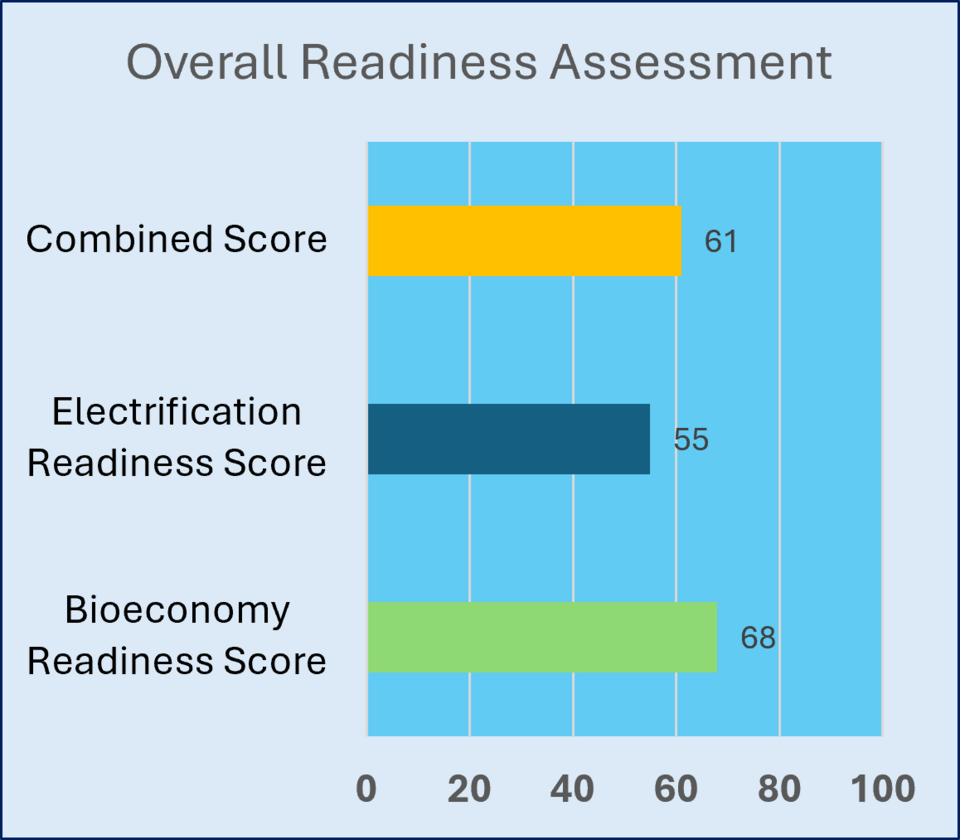
Conclusions:
- The size of Australia’s land area indicates the country can scale up energy-crop plantations without compromising food security.
- Australia is a major exporter. Bulk handling facilities, grain terminals, and rail networks already move tens of millions of tonnes of plant material annually. Transitioning from exporting wheat to exporting bio-feedstocks, wood pellets and other biobased products requires minimal new basic logistics infrastructure.
- Australia is geographically vast. Moving millions of tonnes of low-density agricultural stubble or forestry residues from inland farms across many kilometres to coastal ports requires significant fuel and freight costs, making raw biomass logistics expensive. This suggests distributed production of biobased products will be most efficient.
- Located directly adjacent to rapid-growth decarbonization hubs (such as Japan, Singapore, and South Korea), Australia is the logical strategic biobased fuel partner. Japan, for example, is introducing sustainable aviation fuel (SAF) blending mandates, and could consider Australia for the supply the bio-based feedstock and finished product.
The full Australia Report is available for purchase by subscribing as a member